About
Learn how to turn a rough-cut slab of wood that has bark still hugging an edge into a stunning bench, coffee table, entry table, or countertop.
The first session includes a discussion of where to buy slabs and what to look for before you purchase. A selection of slabs will be available for purchase, or you can get one on your own. There is a week before the second session to allow time to shop elsewhere. You'll learn about possible local suppliers at the first meeting. If you already have a slab, bring it or a photograph so the instructor can assess it.
Hands-on work on the slabs begins at the second session. You will learn:
- How to make a slab flat, uniformly thick, and smooth.
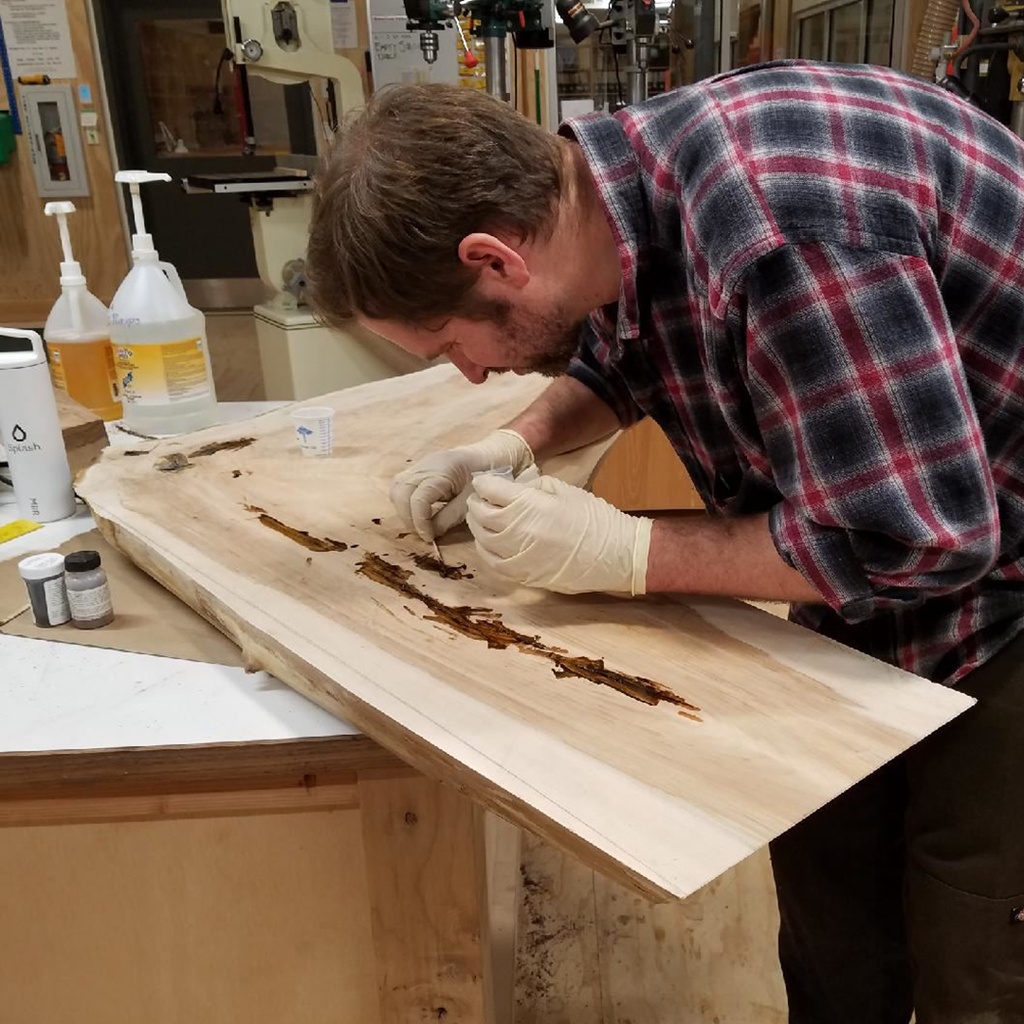
- How to fill small cracks or other gaps with epoxy.
- How to make butterfly joints to stabilize larger cracks.
- How to clean up and smooth a live edge, depending on the effect you want.
- How to choose and apply an appropriate finish.
You'll also learn design options for bases for tables and benches and how to attach slabs to these bases or to cabinets, if you want to use your slab as a countertop. The instructor can help with design of a base that you can build during the class, if time allows, or during Open Studio.
Details
A materials fee of $35, included in the cost of the class, covers shop supplies, epoxy, and finish (Osmo Polyx Hard Wax Oil). If you want to use a large quantity of epoxy to create a special effect such as a river look with embedded stones, you'll need to purchase additional epoxy. The instructor will discuss this as part of the design process.
The cost of the wood is not included in the class fee. For a slab 80 inches long, 24 inches wide and 2 inches thick, figure on spending $100 - $190, based on about $4 - $7 a board foot. Students typically start with wood 2 or 3 inches thick, 4 to 7 feet long, and 18 to 24 inches wide.
Project
The goal is to have you go home with a finished slab big enough for a small project, such as a bench or small table.
Depending on your pace and what is needed for your project, you may need to work during Open Studio to complete your piece. Open Studio is always free for members. Guests can also work during Open Studio to complete a class project without paying an additional fee.